Auto Repair SEO: A Practitioner’s Guide to Ranking Your Shop
Auto repair SEO is the process of making a mechanic shop’s website visible when local customers search for vehicle service. For most shop owners, organic search is the single highest-ROI marketing channel. Traffic compounds month over month. Every visitor is actively looking for nearby help, which means conversion rates outpace almost every other lead source.
Auto Repair SEO explains how to make a mechanic shop’s site clear to Google and locals, prioritize local searches, fix on-page issues, and treat the website as a second storefront.
The guide covers keyword research, local authority, backlinks, and content strategies designed to lift organic rankings and revenue, so paid clicks supplement long-term visibility rather than replace it.
I’ve spent 15 years running campaigns for mechanic shops and service centers. The ones that win online share a few things in common: they nail the technical basics, they optimize for local searches, and they treat their website like a second storefront. This guide covers how to research the right terms, fix on-page issues, build local authority, earn backlinks, and create content that drives real revenue.

Why SEO Matters for Auto Repair Shops
Search engine optimization for an auto repair shop means making your online presence easy for Google to understand and rank. When someone types “auto repair near me” or “brake service” into a search engine, your position in results determines whether customers find you or a competitor down the street.
Context for the industry: there are over 235,000 automobile repair shops in the USA. Your potential customers are choosing between you and dozens of competitors within driving distance. A strong campaign puts your business in front of people at the exact moment they need help. That’s something no billboard or print ad can replicate.
For any business owner running a small business or a multi-location shop, this kind of work isn’t optional. It’s the foundation of your digital marketing strategy and the fastest way to improve online visibility. One mistake I see repeatedly: shops spend thousands on Google Ads without fixing their organic presence first. Paid clicks stop the moment you pause the budget. Organic positions keep working while you sleep.
How to Find the Right Keywords
Keyword research is where every effective strategy starts. You need to know what phrases potential customers actually type when they need an auto mechanic. Choosing the right terms gives your shop a competitive advantage from day one.
Start with a free planner tool. If you have a Google Ads account, the built-in planner works well. Ubersuggest, a popular tool built by Neil Patel, also lets you research several phrases on a free plan. You can set up a free Google Adwords account just to access the planner without running ads. Semrush, another widely used platform, offers limited free searches for deeper competitive data.
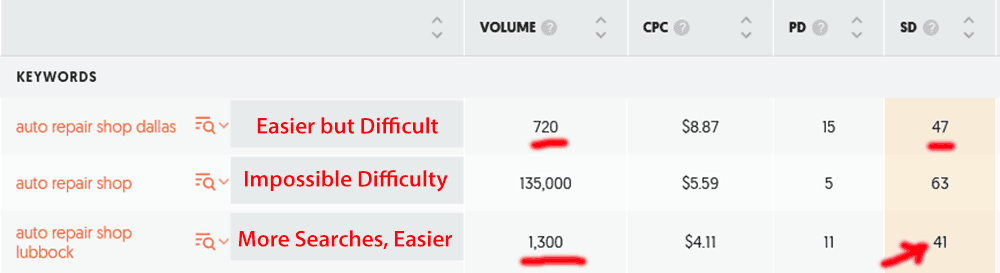
Focus on these categories:
- Location-based terms like “[service] + [city name]” or “car repair shop near me.” Local phrases with city or state names are much easier to rank for and more likely to convert. These are the best terms to target first because they connect geography to buyer intent.
- Service-specific terms like “transmission work,” “brake service,” or “oil change.” These connect with people who already know what they need. High-intent traffic converts well.
- Brand-of-car terms like “BMW mechanic near me.” If your shop specializes in certain makes, these attract a loyal, high-value audience willing to pay premium rates.
The goal isn’t to stuff every phrase onto one page. Map each group to a dedicated service page. One page per core offering, each targeting its own primary phrase. For more on term selection in this space, see our guide on car dealership keywords.
Local SEO and Your Google Business Profile
Local SEO is the biggest lever for any service center. When someone searches for a shop near them, Google shows a map pack powered by Google Maps data first, and that’s where most clicks go.
Claim and Complete Your Profile
Google Business Profile (formerly Google My Business) is the most important local asset you have. Claim your listing with accurate contact information, hours, and high-quality images of your shop and team. Keep your business page updated with posts showing recent jobs and respond to every review. A complete profile with photos, service categories, and regular updates performs better in Google Maps results than a bare-bones listing.
Make sure your name, address, and phone number are identical across every platform. Inconsistencies confuse crawlers and hurt your local results.
Citations and Local Directories
A citation is your business listed on directories like Yelp, BBB, and industry-specific sites. Each consistent listing reinforces trust with Google. For local businesses in the repair and maintenance sector, consistency across all platforms is non-negotiable.
Customer Reviews Build Credibility
Positive reviews directly impact local visibility. Encourage satisfied customers to leave feedback on your Google My Business listing. Reviews that mention specific services (“great brake job” or “honest transmission diagnosis”) add relevance and build credibility.
Respond to every review. It signals to both Google and future customers that your shop’s team is engaged and reliable. Negative reviews handled professionally often convert skeptics into customers.
On-Page SEO for Your Auto Repair Website
On-page work means adjusting what’s actually on your website so Google can understand and rank each page correctly. Here’s the priority list:
- Title tags and meta descriptions. Every page needs a unique title containing your target phrase. Your home page might target “best vehicle service in [city]” while a subpage targets “transmission work [city].” The meta element for description should be a factual summary, not marketing fluff.
- Heading structure. One H1 per page with your primary term. Use H2 and H3 tags to organize subtopics. Search engine results pages favor well-structured content.
- Homepage and service pages. Your homepage should clearly state what you do and where. Create individual pages for brakes, oil changes, engine work, glass, AC, and transmission. Each needs unique content. We covered a similar approach for collision and body shop sites.
- Speed and mobile. Most people searching for vehicle help are on their smartphone with an urgent need. Compress images, use responsive design, and test across devices. Google Search Console flags mobile usability issues for free.
- Image alt text. Descriptive file names like “brake-service-dallas.jpg” beat “IMG_4521.jpg” for both accessibility and performance. If you use WordPress, adding alt text takes seconds per image.
Track your progress in Google Analytics and Search Console. Find pages stuck on page two and tweak them until they break through. These two free tools give you the data to make smart decisions instead of guessing.
Backlinks and Local Link Building
A backlink is a link from another website to yours, and quality inbound links remain one of the strongest signals Google uses to evaluate authority. For the auto service industry, quality matters far more than quantity.
Effective strategies include:
- Sponsoring local events (charity car shows, school fundraisers, youth sports teams)
- Getting listed in your chamber of commerce directory
- Partnering with complementary businesses: parts suppliers, dealerships, body shops
- Contributing expert tips to local news publications or community blogs
Avoid buying links. Google penalizes link schemes, and recovery is painful. If outreach feels overwhelming, an experienced digital marketing agency that specializes in the automotive sector can handle it. Look for proven results, not just promises. For parts-focused shops, we have a separate guide covering auto parts performance.
Target These Service-Level Terms
One area competitors consistently miss is building dedicated content around specific service categories. Below are the terms worth targeting with individual pages on your website.
- General: “auto repair near me” (301K/mo), “auto repair shops” (110K/mo), “repair shop near” (27K/mo). Competitive but essential for your homepage.
- Oil change: “oil change” (550K/mo), “oil change prices” (22K/mo). A dedicated page pulls significant traffic for any shop offering this routine maintenance.
- Brake work: “brake shop” (27K/mo), “brake service” (22K/mo). Safety-focused content converts well because the buyer is urgent.
- Transmission: “transmission shop” (90K/mo), “transmission work” (33K/mo). High-ticket jobs mean positioning here pays off quickly.
- Glass: “windshield replacement” (165K/mo), “glass service” (90K/mo). Dedicated pages gain traction faster because competition is thinner. Related: our guide to car wash visibility covers another niche with similar dynamics.
- AC: “car ac fix” (40K/mo). Volume spikes in summer, making this a smart seasonal target for your blog.
- Mobile mechanic: “mobile mechanic” (90K/mo). If you offer mobile work, this category is underserved online.
- Electric systems: Electrical diagnostics is a specialty niche with low competition and strong buyer intent.
Build a page for each category you handle. Link between related pages to strengthen your site map and internal architecture. Your homepage should connect to every main service page, and each should link back. For detailing-focused shops, we have a separate list for car detailing terms.
Content That Moves the Needle
Creating content isn’t about volume. It’s about answering the questions customers actually ask. Write about common car problems in plain language on your blog. “What does the check engine light mean?” and “How often should I change my oil?” bring organic traffic to your site month after month.
From the practitioner side: define technical terms before going deep. Include decision logic like “If you hear grinding when braking, pads are likely worn to metal. Get service within days, not weeks.” Share edge-case warnings from real shop experience, like when a customer’s “oil change” turns into a valve cover gasket job because the tech spotted a leak during inspection. This is what separates useful content from generic marketing strategies.
Update regularly to keep material current. Fresh content signals an active, authoritative web page. Information that’s outdated erodes credibility with both readers and Google.
Get Started with Your Shop’s Online Presence Today
You have two paths. Do it yourself: start by claiming your Google Business Profile today, research terms using a free planner tool, build out service pages, publish useful content, and earn links through community involvement. This works if you have time and willingness to learn the basics of on-page work.
Or hire help. Look for a digital marketing agency with automotive clients and proven results. A good provider will audit your auto repair shop website and show you exactly where the gaps are. Our team offers consulting for the auto repair industry and a free website audit so you can see where your business stands today. Whether you need someone to improve your website or run a full campaign, we tailor solutions to the auto service industry. Contact us to see your shop climb higher in local results.
Frequently Asked Questions
What is auto repair SEO?
It’s the process of making a mechanic shop’s website and Google listing visible in search results when local customers look for vehicle service. This includes targeting the right terms, on-page work, link building, and local citation management.
How long does it take to see results?
Most shops start seeing measurable improvements within three to six months. Local map pack positions can improve faster, sometimes within weeks, while organic page-one spots for competitive terms take longer to build.
Can I handle this myself, or should I hire an agency?
You can absolutely start on your own. Claiming your Google listing, gathering reviews, and building service pages are all doable without outside help. If you want faster results or lack the time, hiring a specialized agency makes sense. Either way, understanding the fundamentals helps you make smarter decisions about your marketing budget.
What are the most important factors for a local mechanic shop?
Profile completeness, consistent citations, positive customer reviews, on-page targeting, and quality links from local sources. A mobile-friendly website design and fast page speed also play a significant role in how Google evaluates your site.
How much does this cost for a small auto repair shop?
DIY costs are minimal: hosting, a WordPress site, and your time. Professional services typically range from $500 to $2,000 per month depending on competition level, number of service pages needed, and whether local or broader geographic targeting is the goal. The return usually outpaces the investment within six to twelve months for shops in mid-sized markets.